
A candle flame that stays unusually tall, flickers aggressively, smokes or repeatedly flares should be treated as a sign to stop the burn. Extinguish the candle, let it cool completely, then check the wick, melt pool and surroundings before lighting it again.
A flame does not need to be perfectly still or identical on every candle. What matters is a clear change from normal behaviour: a flame that remains much larger than expected, leans strongly, produces soot or keeps becoming unstable.
In most cases, the first things to check are simple: wick length, carbon build-up, debris in the wax, draughts and how long the candle has already been burning.
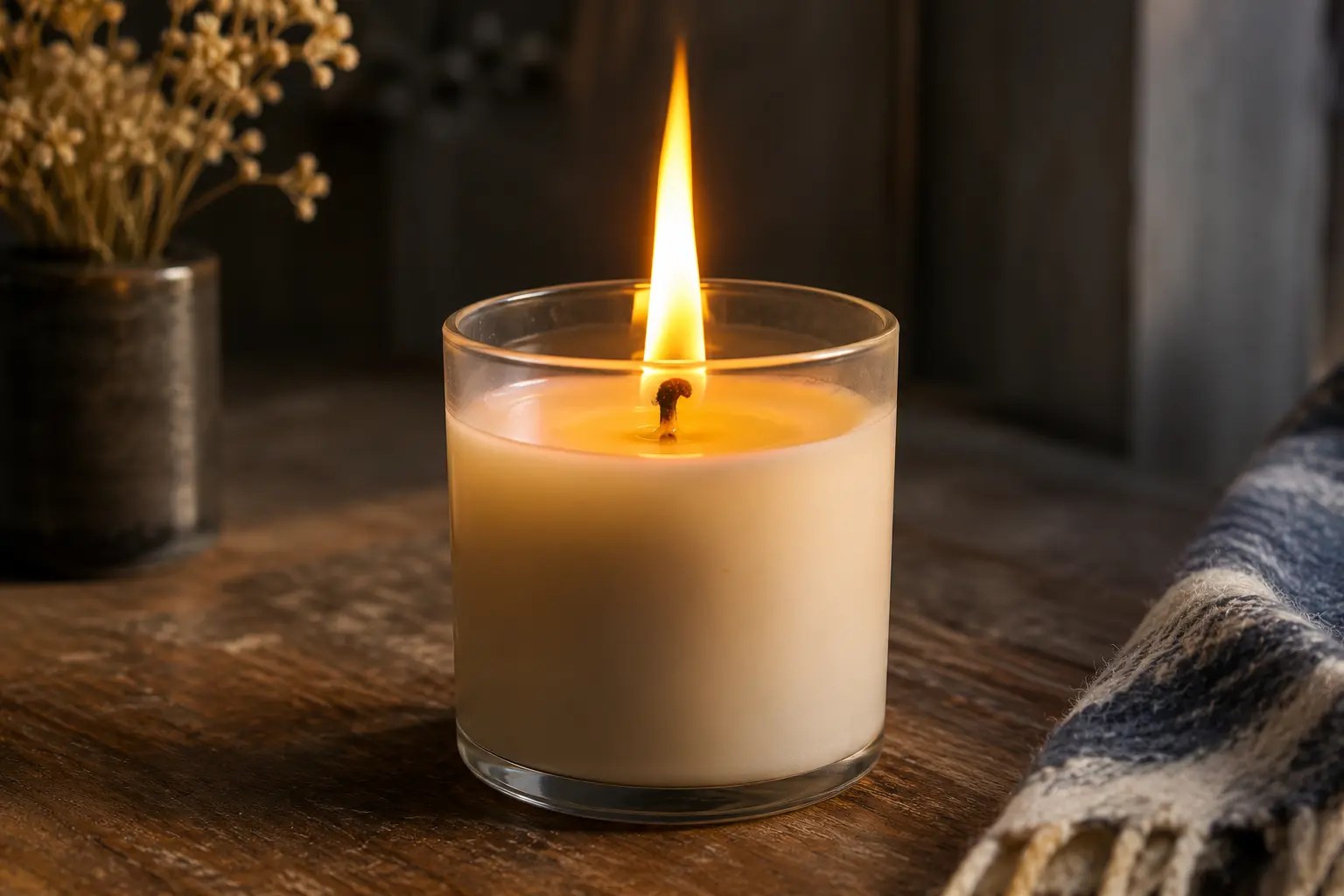
High candle flame: what to check first
| What you notice | What may be happening |
|---|---|
| Flame is tall and steady | The wick may be too long or carrying excessive carbon build-up |
| Flame leans or flickers strongly | A draught or moving air may be disturbing it |
| Flame suddenly flares | Wick trimmings, matches or other debris may be adding fuel |
| Flame grows larger later in the burn | The wick may have developed a carbon cap, particularly after a long session |
| Flame sits unusually close to one side of the jar | The wick may have shifted off centre |
| Large flame returns after normal maintenance | Stop using the candle and ask the maker for product-specific advice |
What counts as a candle flame that is too high?
There is no useful universal flame height that applies to every candle.
Different wick sizes, waxes and candle formats naturally produce different-looking flames, so measuring a flame with a ruler is not the answer.
Instead, look at its behaviour.
A flame deserves attention if it:
- remains noticeably taller than it normally does;
- flickers or leans strongly despite being in a calm room;
- repeatedly flares;
- produces persistent visible smoke or soot;
- develops a large carbon build-up on the wick;
- moves unusually close to the side of a container.
If the flame looks abnormal and you are unsure why, extinguishing it is the sensible choice. You do not gain anything by continuing to watch a questionable burn to see what happens.
An overlong wick is a common cause
The wick controls how fuel reaches the flame.
If too much wick is exposed, the flame can become larger and less stable than intended. A long or crooked wick can also contribute to smoking, soot and uneven burning.
Before each burn, check the wick while the candle is completely cold and trim it to the length specified for that candle.
Do not assume that shorter is always safer. Cutting a wick excessively short can create a weak flame or leave the wick struggling in the melt pool.
The goal is the correct wick length, not the shortest possible wick.
A mushroomed wick can make the flame grow
As a candle burns, carbon can accumulate at the tip of the wick. Sometimes this forms a dark, rounded cap often described as mushrooming.
A small amount of carbon build-up can occur during normal use, but a large cap adds mass at the top of the wick and may be accompanied by a larger, less stable flame.
This is one reason very long burn sessions should be avoided.
If the candle reaches the maximum burn time stated by its maker, extinguish it even if the wax surface has not melted exactly as you expected.
Once the candle is completely cold, remove loose carbon and prepare the wick according to its care instructions before the next burn.
Debris can act as extra fuel
A melt pool should be kept clear of anything that does not belong there.
Wick trimmings, match fragments and other combustible debris can provide additional fuel close to the flame. That can cause unexpected flaring or change the way the candle burns.
If something falls into the liquid wax, do not reach into a burning candle to retrieve it.
Extinguish the flame, wait until the candle has cooled and remove loose material safely before the next use.
Draughts can make a flame look larger and unstable
Sometimes the problem is not the candle at all.
An open window, fan, air-conditioning vent, heat pump or busy doorway can push air across the flame.
The result may be a flame that leans, dances strongly, burns unevenly or produces soot on one side of the vessel.
Once the candle is extinguished and completely cool, move it to a stable, heat-resistant surface away from strong air movement before using it again.
A long burn can make the flame larger
A candle can behave differently several hours into a burn than it did when first lit.
The wax is warmer, the melt pool is deeper and carbon may have accumulated on the wick. If the session continues beyond the candle’s intended limit, the flame can become larger and smoking or soot can increase.
That is why maximum burn times matter.
Do not extend a session simply because you want the melt pool to reach the edge of the jar or because some wax remains around the sides.
What to do if your candle flame becomes too high
- Extinguish the candle. Do not wait for a persistently oversized or unstable flame to correct itself.
- Make sure the wick is fully out. Keep watching until there is no flame or glowing ember.
- Leave the candle where it is. Do not carry a hot vessel or pour away liquid wax.
- Let it cool completely. The wax should be solid before you inspect or adjust anything.
- Check for debris. Remove loose wick trimmings, match fragments or other foreign material.
- Check the wick. Once cold, trim or remove loose carbon only according to the candle’s care guidance.
- Check the surroundings. Make sure there is no strong draught and that the candle has sufficient space around and above it.
- Inspect the vessel and wick position. Do not relight if the container is damaged or the wick has moved into an unsafe position.
What if the high flame comes back?
If you have allowed the candle to cool, prepared the wick correctly, removed debris and moved it away from draughts but the flame becomes abnormally large again, stop using the candle.
A customer should not need to start altering wax, repositioning a wick or modifying the candle to correct repeated abnormal burning.
Contact the maker with a clear photograph of the candle, the wick and — if it can be photographed safely — the flame during the abnormal burn. Include the product name and any batch or order information available.
What if the wick has moved to one side?
A container candle is designed around the position of its wick.
If the wick has moved substantially away from the centre, the flame may sit closer to the glass than intended and heat one part of the vessel more directly.
Do not try to push a hot wick back into position.
If the wick has detached, shifted significantly or remains unusually close to the wall of the vessel after the candle has cooled, leave the candle unlit and contact the maker.
When should you not relight the candle?
Do not relight a candle if you find:
- a cracked, chipped or otherwise damaged vessel;
- a wick that has detached or moved substantially towards the side;
- foreign material that cannot be removed safely;
- evidence that the candle repeatedly produces an abnormally large flame despite normal care;
- any other damage that makes you unsure whether the candle is still sound.
Also stop burning once the candle reaches the minimum remaining-wax level given in its instructions.
The final wax in the bottom of a container is not something that has to be consumed at all costs. It can form part of the candle’s intended safety margin.
Do not put a high flame inside another container
A candle that is already burning abnormally should not be placed inside an improvised lantern, vase or enclosed decorative vessel in an attempt to control the flame.
Additional surrounding material can change ventilation and heat build-up around the candle.
Only use a candle inside another holder or warming arrangement when the products are specifically designed to be used together and there is sufficient ventilation.
Frequently asked questions
Can a candle flame be high just after lighting?
A flame can move as the wick catches, but it should settle into normal behaviour. If it remains unusually tall, begins smoking, repeatedly flickers or looks unstable, extinguish the candle rather than waiting indefinitely for it to improve.
Will trimming the wick fix a high candle flame?
It can help when excess wick length or carbon build-up is the cause. Only trim the wick when the candle is cold, and use the length specified for that candle. A draught, debris or another problem may still be responsible.
Why does my candle flame get bigger after a few hours?
Carbon can accumulate on the wick during a long burn, while the candle and melt pool also become progressively warmer. Extinguish the candle at its stated maximum burn time rather than extending the session.
Why is my candle flame flickering so much?
Moving air is a common cause. Check for open windows, fans, vents, heat pumps and busy walkways. Persistent flickering can also occur with an overlong wick or abnormal burn, so extinguish and inspect the candle if moving it away from draughts does not resolve the issue.
Why is my candle producing black smoke?
Visible smoke and soot can be associated with an overlong or carbon-heavy wick, draughts or an excessively long burn session. Extinguish the candle, allow it to cool and check the wick and surroundings before the next use.
Is a very high candle flame dangerous?
An abnormally large flame should not be treated as normal. It can increase heat, soot and the risk posed by nearby combustible material. Extinguish it and investigate the cause before deciding whether to use the candle again.
The simple answer
A persistently high candle flame is a stop signal rather than something to work around.
Extinguish the candle, let it cool completely, then check the wick, debris, draughts and burn time.
If the obvious cause can be corrected through normal candle care, follow the product instructions before the next burn. If the abnormal flame returns, leave the candle unlit and contact the maker.


